LitPivot: AI for Literature-Grounded Research Ideas
See how LitPivot uses AI to connect research ideas with relevant papers, support evidence-backed revisions, and help scientists assess novelty and research fit.

How LitPivot Uses AI to Help Researchers Rethink Ideas
A research idea rarely survives its first encounter with the literature unchanged. A paper may show that a proposed contribution has already been explored. Another may expose a gap, suggest a more precise problem, or reveal that the planned evaluation doesn't test what the researcher actually wants to know. The hard part isn't just finding papers. It's deciding what those papers mean for an idea that's still taking shape.
LitPivot, a research system developed by Ai2 with collaborators at the University of Pennsylvania, is built around that problem. It links proposal writing with literature discovery and revision, so researchers can examine evidence while they're developing an idea - not only after they've drafted it. The system organizes papers around parts of a proposal, delivers critiques with supporting excerpts, and suggests revisions the researcher can accept, edit, or reject.
In other words, the practical role for AI here isn't deciding which ideas deserve to exist. It's helping researchers inspect the evidence behind their choices. This article explains how LitPivot works, what its early studies report, where it may be useful, and what its results do - and do not - say about AI-assisted research.
Why research ideas change when they meet the literature
Research is often described as a sequence: identify a problem, review prior work, develop a contribution, and evaluate it. Real projects are messier. Researchers move back and forth between steps because new evidence changes what feels important, novel, or feasible.
A literature-initiated pivot is a change in research direction prompted by reading prior work. It can take at least two forms. A researcher may distinguish an idea from existing work to clarify its novelty. Or they may align the idea with a known line of research by building on an established result, method, or limitation. Neither kind of pivot is automatically a retreat. Sometimes the strongest contribution only shows up after the original framing gets adjusted.
Ai2's analysis of meeting notes from four completed computer science projects identified 21 literature-initiated pivots across those projects. That observation matters because it shows pivots weren't just rare exceptions or a sign that planning had failed. They were part of how those projects developed. The LitPivot project itself also went through two pivots before its contributions were finalized.
The hard part is connecting critique to a useful next step
Finding a paper that challenges an idea is only the first step. The researcher still has to work out what the finding means. Does it invalidate the problem, overlap with the proposed contribution, or point to a method they could build on? And if it changes the framing, does the evaluation plan need to change too?
In a formative study described by the team, five researchers developed proposals using a text editor and standard search tools. They had a tough time figuring out how to refine their ideas while critically evaluating them against the literature. When a paper raised questions about novelty, they wanted concrete revision suggestions grounded in the prior work - not just a generic warning that something similar might exist.
That distinction is important. A search result isn't the same thing as a research assessment, and a general-purpose chat response can't replace checking the evidence. If a tool points to overlap but doesn't show which paper supports the concern, the researcher ends up doing the work themselves. And if it suggests a rewrite without making the basis clear, the rewrite may sound reasonable while drifting away from what the literature actually supports.
LitPivot's design addresses this by treating idea development and literature selection as connected. The researcher points to the part of the proposal they want to assess, chooses which papers should inform the evaluation, and reviews a critique that ties back to specific evidence. The goal is to support a decision - not hide how that decision was made.
How LitPivot connects literature to proposal revisions
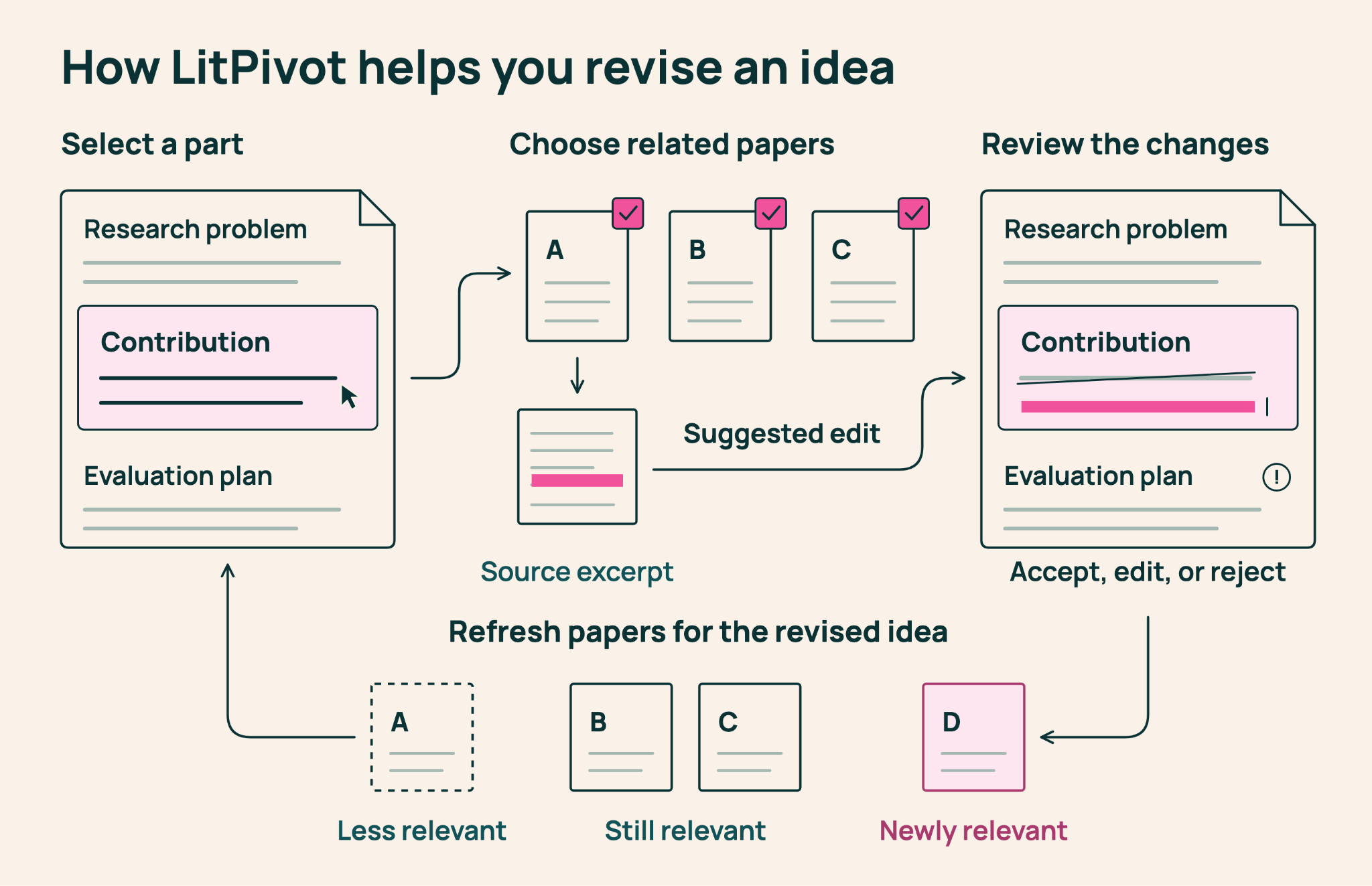
LitPivot starts with a short proposal in an editor. The researcher turns on facet highlighting, which breaks the idea into three segments: the problem, the proposed contribution, and the evaluation plan. These pieces are related, but each one answers a different question. The problem statement needs evidence that the problem is real and a clear explanation of why it matters. The contribution needs to be distinguished from what earlier work has already done. The evaluation needs to test whether the proposed work answers the research question.
The researcher clicks a facet to assess it. On the side, an adjacent panel groups related papers based on the selected part of the proposal. For example, if the evaluation plan is selected, the system can organize papers around the evaluation methods they use. The researcher then chooses which papers to include and asks for an assessment. LitPivot presents a suggested revision along with excerpts from the selected studies that support the critique.
Three facets, three kinds of questions
This facet-based structure helps keep different questions from blending together during early drafting:
- Problem: Do the selected papers support the claim that this is a real problem? What reasons or evidence show why it matters?
- Contribution: What have the selected studies already addressed? What limitations, gaps, or future-work directions help clarify what's still missing?
- Evaluation: Do the proposed tests address the research question? How have related studies evaluated similar work?
This separation isn't only a UI choice. It forces a more precise kind of interrogation. A contribution can look promising while the evaluation plan is weak. A problem can be genuinely important while the proposed solution overlaps too much with existing work. Treating each part as its own assessment target can surface those mismatches earlier.
As the idea changes, the workflow changes too. After a revision, LitPivot reranks the literature based on the revised facet. A paper that was relevant to one version of a proposal might become less relevant once the problem or contribution gets narrowed. Instead of treating the initial search set as fixed, the researcher can request additional papers or refresh the ranking.
That flexibility reflects a broader point: evidence selection shouldn't be a one-time setup when the claim itself is still evolving. Updating one facet can also leave another facet behind. For instance, if the contribution changes substantially, an evaluation plan that used to test it may no longer fit. LitPivot can flag passages that may need attention, but the researcher still decides whether to accept, edit, or reject the suggested change.
The researcher remains in control of the evidence
LitPivot doesn't simply generate a proposal and ask the user to trust it. Researchers choose which papers to include in each assessment and remain responsible for the draft. They can check the supporting excerpts, rewrite the suggestion if needed, or decline it.
That matters in practice. The quality of the system's answer depends partly on what it retrieves and partly on what the researcher chooses to treat as relevant. If important work is missing or if a selected paper isn't actually comparable, the critique can be incomplete. Showing excerpts and making the selection step visible makes those limitations easier to inspect - but it doesn't remove the need for domain judgment.
The source describes LitPivot as retrieving papers through Asta Paper Finder. For a closer look at the system and its research context, see Ai2's LitPivot post on Hugging Face. The overall workflow stays simple: select a facet, review related literature, choose evidence, assess the draft, and reconsider the evidence after the idea changes.
What the studies found - and what they cannot prove
The main lab study included 17 researchers. Each participant worked on one assigned idea using LitPivot and another using a baseline setup: a text editor plus an AI tool for asking questions about selected papers. Both conditions used the same collection of papers. Two domain experts, who didn't know which system was used for each proposal, rated how well participants used relevant literature to support and justify their ideas.
Proposals developed with LitPivot received higher ratings on that criterion. Participants also reported stronger understanding of the surrounding literature and greater self-reported improvement in novelty and usefulness than they reported with the baseline. The source describes the expert assessment as finding that LitPivot proposals were significantly better grounded in relevant literature.
It's encouraging, but scope matters. The expert rating focused on literature grounding and justification. It wasn't a general measure of scientific truth, eventual publication success, or whether the ideas would lead to useful discoveries. The study also involved a relatively small group of participants and assigned ideas in a lab setting. That's evidence about this workflow under those conditions - not proof that AI reliably improves research across every field and every stage.
A concrete example of an idea becoming more specific
One participant started with a proposal to generate consistent, factual synthetic medical notes. During the work, LitPivot surfaced a gap in the selected literature: consistency across multiple hospital visits wasn't well covered. The researcher reviewed the abstracts and removed papers focused on notes from a single visit. After another assessment, they narrowed the idea toward detecting contradictions across notes from multiple visits.
This shows a two-way relationship. The literature helped the participant sharpen the research question, and the refined question changed which papers mattered for the assessment. The tool didn't just polish the wording - it shifted both the scope and the evidence used to evaluate the idea.
That point extends beyond this medical-notes example. Early proposals often mix claims at different levels of specificity. A broad statement can sound important while being hard to test. A narrower statement can clarify what the work contributes and what evidence is actually relevant. A useful research workflow has to make that narrowing possible without silently discarding prior work that doesn't neatly fit.
A smaller follow-up study points to broader use
In a follow-up study, five researchers used LitPivot on their own ongoing projects in 30-minute sessions. Participants used it at different points in the project cycle: two explored new ideas against the literature, while three refined the framing of more mature ideas. One researcher noted that seeing parallel concepts from different domains helped them reframe a contribution.
This follow-up suggests the workflow could be useful beyond the earliest ideation stage. It also raises a practical adoption question: a tool that works well with a short proposal may need different controls when applied to a mature project with a larger literature set and more established claims. The studies offer an initial look at potential use, not a complete evaluation of long-term research practice.
What LitPivot suggests about AI in research
LitPivot is part of a broader effort to apply AI to scientific discovery. Ai2 describes related systems, including Theorizer (theory generation from published findings), AutoDiscovery (synthesis and hypothesis generation and testing on data), HARPA (hypotheses informed by emerging research trends), Scideator (recombining elements of prior work and assessing novelty), and IdeaSynth (iterative refinement grounded in the literature).
These systems tackle different parts of the research process. LitPivot's narrower contribution is making the link between literature selection and proposal revision explicit. That contrasts with tools that focus mainly on generating drafts, summarizing large sets of papers, or evaluating novelty as a single yes-or-no judgment.
The distinction is important because novelty isn't something a model can reliably certify. Ai2's study Old Ideas, Novel Problems highlights issues with automated novelty evaluation, including how small prompt changes can shift an AI judge's verdict on the same ideas. LitPivot approaches the problem differently. Instead of hiding literature selection behind a final score, it lets researchers change which papers they're using as the proposal develops and inspect critiques tied to those papers.
Potential value for research teams
For a research group, the appeal may be less about saving a fixed number of hours and more about making reasoning easier to check. A team could use a facet-based workflow to discuss questions like:
- Which part of the proposal is currently uncertain: the importance of the problem, the novelty of the contribution, or whether the evaluation matches the claim?
- Which papers are being treated as the comparison set, and why?
- What evidence supports a proposed change in framing?
- If the contribution changes, does the evaluation plan need to change too?
Making these steps visible could help collaborators spot disagreements earlier. It could also make it easier to explain why a proposal changed between meetings. Still, these are plausible workflow benefits, not verified business outcomes from the studies as reported. The source doesn't claim measured productivity gains, lower research costs, or improved publication rates.
The approach might also apply to longer writing tasks, like drafting an introduction, but the source describes that as a possible extension rather than a demonstrated capability. Turning a short proposal into a paper introduction brings new requirements: synthesizing across a larger body of work, citing accurately, and explaining how the contribution fits into the field. Any useful extension would need to keep evidence traceability intact, rather than turning references into decorative citations.
The limits are part of the product question
No literature-grounded AI workflow can guarantee comprehensive coverage. Search and ranking systems can miss relevant papers, overemphasize well-known work, or surface studies that share terminology while differing in substance. Excerpts can help researchers check a critique, but a short quote can't carry every qualification a paper includes. And generated revisions can overstate what the evidence supports if the user doesn't review them carefully.
There's also a responsibility issue. Researchers stay accountable for representing other work accurately and for deciding whether an idea is genuinely distinct. AI can help organize the review process, but it can't shift scholarly responsibility onto a tool. In regulated or sensitive areas - like medical research - validation standards, data handling, and expert review are especially important.
For teams considering tools in this space, the right evaluation isn't just whether the output reads well. Look for whether the system shows its sources, lets users control the evidence set, supports corrections, and keeps researchers in charge of consequential decisions. A polished interface helps, but traceable reasoning matters more.
Conclusion
LitPivot addresses a real weakness in many research workflows: literature review and idea development often get treated as separate activities, even though each can change the other. By splitting a proposal into problem, contribution, and evaluation facets, the system helps researchers connect specific claims to selected papers, inspect evidence-backed critiques, and revise the idea as the relevant literature shifts.
The early findings are promising, especially for literature grounding and participants' understanding of the surrounding work. They should be read at the level the studies support: as evidence that a carefully designed workflow can help researchers assess and refine proposals - not as proof that AI can certify novelty or replace scholarly judgment.
If you're evaluating AI tools for research, start with the decision process, not the generation demo. Ask whether users can choose and inspect the evidence, see why a revision is suggested, and stay in control of the final claim. That's the difference between AI that just produces research-sounding text and a tool that can support how research ideas actually develop.